Constant muscle, tendon, and joint pains affect the ability to work, exercise, sleep, and even carry out day-to-day activities. When conventional physiotherapy fails to alleviate pain, Radial Extracorporeal Shockwave Therapy (rESWT) can complement a comprehensive rehabilitation program. Physiofitguru Clinic in Mulund offers radial shockwave therapy in addition to exercise and physiotherapy.
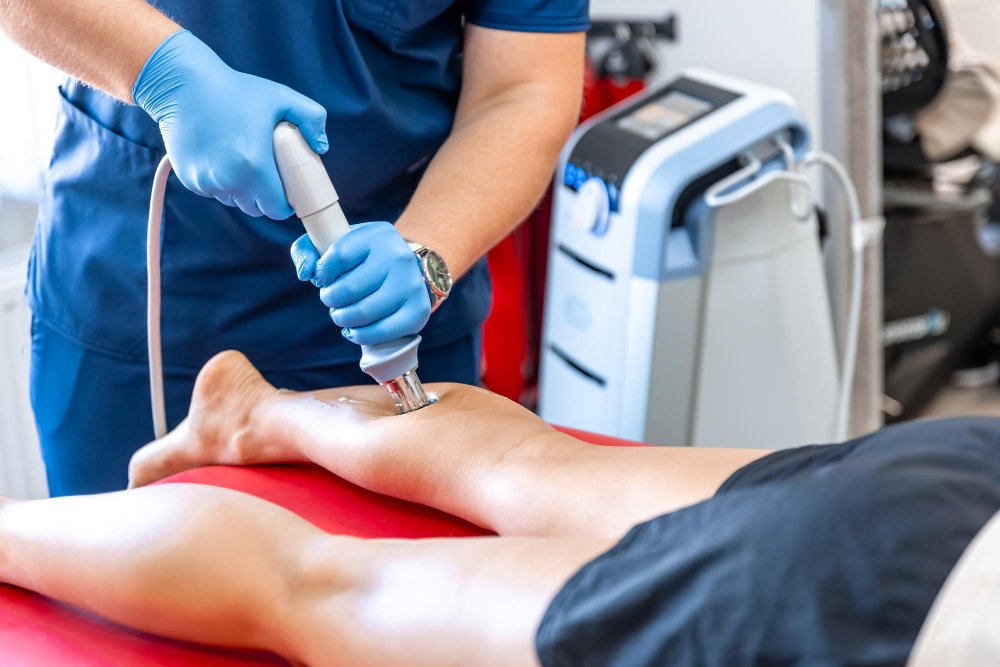
The radial shockwave treatment involves delivering mechanical acoustic pressure waves to the area using a hand-held applicator device. Contrary to electrical stimulation, the treatment uses mechanical waves. Scientific evidence shows that extracorporeal shockwave therapy helps alleviate pain and enhance functionality in different cases of tendinopathy depending on the patient and treatment parameters.
1. Helps Reduce Chronic Pain
One of the common reasons why patients seek shockwave treatment is their constant pain. A systematic review and meta-analysis of 45 randomized studies conducted in 2024 established that ESWT helps to significantly alleviate pain in cases such as plantar fasciitis, lateral epicondylitis (tennis elbow), chronic Achilles tendinopathy, and rotator cuff tendinopathy.
When a patient suffers from persistent tendon or heel pain, alleviating the pain helps the patient to engage in strengthening, stretching, mobility, and functional exercises. This is because shockwave therapy is most useful when it is combined with other components in a comprehensive rehabilitation process.
2. Supports Recovery in Tendon and Soft-Tissue Problems
Tendon injuries are notorious for their difficulty healing due to the long-term repetitive exposure they have often endured. Shockwave therapy appears to affect biological factors associated with the healing process at the cellular and tissue levels.
Several studies have shown good results from ESWT use in terms of reduction of pain and increase in functionality in patients with various lower-limb tendinopathies. A meta-analysis of 29 randomized controlled trials has concluded that the method shows a positive impact on pain and function, but its efficacy varies depending on the type and dosage of shockwave therapy.
At Physiofitguru, it is possible to use shockwave therapy as part of a rehabilitation programme tailored according to the patient’s diagnosis, symptoms, activity level, and recovery goals. According to the clinic, the treatment is based on the combination of advanced technologies and rehabilitation, not on a single method alone.
3. Can Improve Function and Help Patients Return to Activity
Pain is only one side of any injury. Weakness, limitations in movement, walking, and sporting performance often persist despite decreasing pain. There is some evidence which suggests that ESWT may be effective in improving functional outcomes in some musculoskeletal conditions.
For instance, systematic reviews have shown positive results of the therapy use in the treatment of chronic plantar fasciitis, and lower-limb tendinopathy research has proven the efficacy of the method in reducing pain and improving functionality.
For an active person, reduction of pain is not the final aim of treatment. The major goal is restoration of movement and strength in order to gradually return to full functioning and sporting activities. This is the reason why the therapy should be used in combination with suitable exercises and a load management programme.
4. It Is Non-Invasive and Usually Requires No Downtime
Yet another benefit is that radial shock wave therapy is non-invasive. No injections or cuts are involved and the treatment is delivered into the body through the skin by an applicator.
According to Physiofitguru, a typical treatment procedure lasts approximately 15 minutes and allows patients to get back to their normal activities after the treatment, yet the extent of activity that is allowed varies based on the patient’s condition.
Shockwave treatment can be a useful tool for continuing work or training during the treatment course, but one should not assume that it is a substitute for medical or surgical treatment without proper medical assessment.
5. May Reduce the Need for More Invasive Treatment in Selected Cases
In cases of chronic musculoskeletal disorders, shockwave therapy can serve as a non-invasive alternative to more invasive procedures before they are considered. The results of shockwave treatment are particularly positive in cases of plantar fasciitis and certain types of tendinopathy, yet the strength of evidence varies depending on the disorder.
One should understand that “faster recovery” does not mean “instant recovery”. The process develops over time, and the success depends on the diagnosis, the duration of the illness, the condition of tissues, physical activity, exercise routine, and personal recovery ability.
What Conditions Can Be Treated?
Physiofitguru lists several conditions for which shockwave therapy may be considered, including plantar fasciitis/heel pain, Achilles tendinopathy, patellar tendinopathy (jumper’s knee), tennis elbow, proximal hamstring tendinopathy, calcific shoulder tendinopathy, rotator cuff tendinopathy, greater trochanteric pain syndrome, shin splints/medial tibial stress syndrome, selected muscle injuries, myofascial trigger points, and some osteoarthritis-related problems.
However, shockwave therapy is not appropriate for every injury or every patient. A physiotherapy assessment is important before treatment to determine whether the condition is suitable and whether medical evaluation is required.
Is Radial Shockwave Therapy Painful?
Treatment may be slightly uncomfortable or even painful at times, especially if the applicator is placed in an area that causes sensitivity. Pain levels are normally adjustable depending on the tolerance level of the patient. Physiofitguru asserts that pain levels normally ease immediately after treatment.
There could be some temporary pain or soreness following the treatment. It has been found out from research that side effects are normally manageable.
How Many Sessions Are Usually Needed?
There is no set number of sessions that will suit everyone. Physiofitguru reports that on average, it takes about 3-5 sessions for the patient to experience an improvement, with sessions conducted once a week for a period of 15 minutes each time.
In the same way, research reveals great differences in the protocols that can be followed. For example, the study reviewing the application of shockwave therapy near the hip and pelvis area shows that most of the protocols applied 3-4 weekly sessions using 2,000-3,000 pulses per session.
Conclusion
Radial shockwave therapy may become a very useful component of non-invasive physiotherapy in the treatment of certain chronic cases related to tendons and the musculoskeletal system. The possible benefits include reducing pain, tendon healing, enhancing function, rehabilitation, and offering a non-invasive method of treatment. Nonetheless, the evidence is not equal in every case, and the shockwave therapy should not be presented as a guaranteed or quick remedy.
At Physiofitguru Clinic in Mulund, the therapy can be adjusted to the individual needs of the patient, based on the individual assessment, and combined with other components of the rehabilitation programme. In cases of persistent heel, tendon, sports, and musculoskeletal pain, the professional assessment can reveal whether shockwave therapy is suitable for the patient.